
Corporal punishment in public and private schools are not addressed by federal law in the United State. Instead, each state set the rules for corporal punishment in schools within the state. In 1977, the United States Supreme Court ruled that the Eight Amendment clause prohibiting “cruel and unusual punishments” did not apply to school students, and the case also clarified that teachers did not require parental permission to carry out corporal punishment. The name of the case is Ingraham vs. Wright, 430 U.S. 651 (1977). Through this case, the Supreme Court upheld the disciplinary corporal punishment policy of Florida’s public schools by a 5–4 vote.
Is school corporal punishment legal in every state?
No, many states have banned school corporal punishment, at least for public schools.
As of 2019:
- Corporal punishment in public schools is prohibited in 32 states and the District of Columbia, either by state law or through school district regulations or similar. There is for instance no state ban against it in North Carolina, but in 2018, the last school district in the state banned it.
- Only Iowa and New Jersey prohibits corporal punishment in both public and private schools.
Where corporal punishment in school is legal, students can be physically punished from kindergarten to the end of high school. This includes legal adults who are still in high school.
In the United States, each state has the authority to define corporal punishment in its state laws – including corporal punishment in schools. Therefore, laws and definitions regarding this issue will vary from state to state.
Alabama is one example of a state that permits corporal punishment in both private and public schools, but has a fairly narrow rule for exactly which corporal punishment that is permitted: the teacher is allowed to punish the student physically using a wooden paddle approximately 24 inches in length, 3 inches wide and ½ inch thick.
Texas is an example of a state where the rules give more flexibility, as teachers in both private and public schools are allowed to paddle children and to use any other physical force to control children in the name of discipline.
Map
In the states marked blue on this map, corporal punishment is prohibited in public schools. In the states marked red, it is legal.
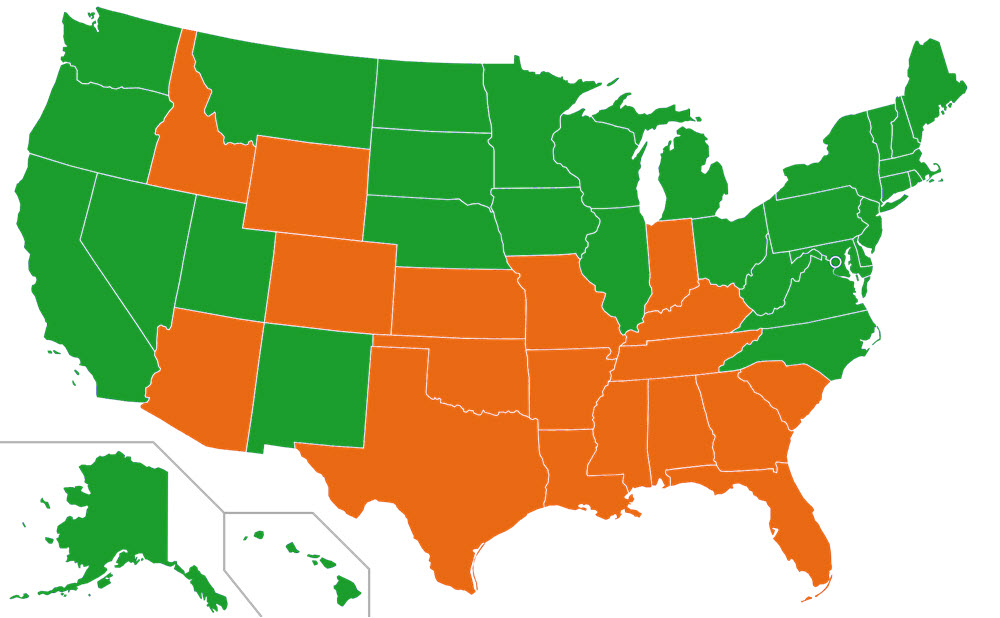
| State | Ban status for public schools | Ban status for private schools |
| New Jersey | Banned since 1867 | Banned since 1867 |
| Massachusetts | Banned since 1971 | Not banned |
| Hawaii | Banned since 1973 | Not banned |
| Maine | Banned since 1975 | Not banned |
| District of Columbia | Banned since 1977 | Not banned |
| Rhode Island | Banned since 1977 | Not banned |
| New Hampshire | Banned since 1983 | Not banned |
| New York | Banned since 1985 | Not banned |
| Vermont | Banned since 1985 | Not banned |
| California | Banned since 1986 | Not banned |
| Nebraska | Banned since 1988 | Not banned |
| Wisconsin | Banned since 1988 | Not banned |
| Alaska | Banned since 1989 | Not banned |
| Connecticut | Banned since 1989 | Not banned |
| Iowa | Banned since 1989 | Banned since 1989 |
| Michigan | Banned since 1989 | Not banned |
| Minnesota | Banned since 1989 | Not banned |
| North Dakota | Banned since 1989 | Not banned |
| Oregon | Banned since 1989 | Not banned |
| Virginia | Banned since 1989 | Not banned |
| South Dakota | Banned since 1990 | Not banned |
| Montana | Banned since 1991 | Not banned |
| Utah | Banned since 1992 | Not banned |
| Illinois | Banned since 1993 | Not banned |
| Maryland | Banned since 1993 | Not banned |
| Nevada | Banned since 1993 | Not banned |
| Washington | Banned since 1993 | Not banned |
| West Virginia | Banned since 1994 | Not banned |
| Delaware | Banned since 2003 | Not banned |
| Pennsylvania | Banned since 2005 | Not banned |
| Ohio | Banned since 2009 | Not banned |
| New Mexico | Banned since 2011 | Not banned |
| North Carolina | Banned since October 2, 2018 (in every school district but not on state-level). | Not banned |
| Mississippi | Banned since July 1, 2019, for students with disabilities or special education plans. Not banned for other students. | Not banned |
| Alabama | Not banned | Not banned |
| Arizona | Not banned, but no reported use | Not banned |
| Arkansas | Not banned | Not banned |
| Colorado | Not banned, but no reported use | Not banned |
| Florida | Not banned | Not banned |
| Georgia | Not banned | Not banned |
| Idaho | Not banned | Not banned |
| Indiana | Not banned | Not banned |
| Kansas | Not banned | Not banned |
| Kentucky | Not banned | Not banned |
| Louisiana | Not banned | Not banned |
| Missouri | Not banned | Not banned |
| Oklahoma | Not banned | Not banned |
| South Carolina | Not banned | Not banned |
| Tennessee | Not banned | Not banned |
| Texas | Not banned | Not banned |
| Wyoming | Not banned, but no reported use | Not banned |